


A million-dollar renovation inspires independent personal study and offers a place to focus.
Soon after arriving at SMC in 2022, Library Director Walter Butler and the library team began reimagining the different spaces throughout SMC’s award-winning 96,000-square-foot structure with its open space interior, multiple floors, seating arrangements, study areas, and group study rooms.
“The world has changed,” explains Butler. Students were returning to the campus following the pandemic, and didn’t just need a place to socialize and be with others. They were looking for a quiet place where they could work on their own.
“That’s in contrast to how libraries had been moving toward building more collaborative spaces over the last decade or so,” Butler says. “Spaces that inspire activity are great. But students are also looking for a place where they can focus and not be distracted.”
When funding for improvements was secured through a $500,000 revitalization grant promoted by District 51 Assemblymember Rick Chavez Zbur, and additional monies from the state were made available for deferred maintenance, the Library team began planning renovations in earnest. While large-scale structural alterations to the building itself were impractical, smaller, more targeted improvements throughout were possible in terms of layout and design. And to ensure that students’ perspectives were incorporated into the design, Butler worked with a group of students in SMC’s Interaction Design Program to get their perspective as both students and designers. Their recommendations were crucial in not only identifying the needs of students, but also opportunities to enhance the overall library user experience.
Even without any construction changes, the renovation was extensive in nature, spanning the reference seating and north seating areas, the entirety of the fifth level — affectionately nicknamed “The Boat” by librarians due to its hull-like structure — and the reference shelves on the lower level. Updated seating and space options would be needed for these areas, along with new paint and carpeting. It was not going to be a simple undertaking.
“During the renovation, we had to leave the library completely,” says Fariba Owlya, a longtime Library staff member. It was worth the wait. When the Library reopened its doors for spring, students were treated to a familiar, but refreshed space that gave them more study alternatives.
“We were looking to populate certain areas with furniture pieces that inspired independent, quiet, focused study,” Butler explains. “We also wanted to make sure there were different options available that could meet students’ different needs.”
The student experience
The emphasis on the student experience is evident in the range of seating and workstation options you can choose from, based on need and personal vibe. For instance, the commons seating area on the main floor had previously been filled with boxy, jet-black upholstered seats and extended maple slat platform benches — better suited for lounging and socializing than study. Butler and the Library team reimagined the place as a spacious, inviting area for study, featuring sleek, cobalt-blue seats with armrests that swivel out to serve as writing surfaces — perfect for balancing a laptop or notebook. Beneath the armrest, a small built-in alcove offers just enough space to tuck away your backpack and books. It’s the ideal spot to get some studying done while keeping an eye on the world around you.
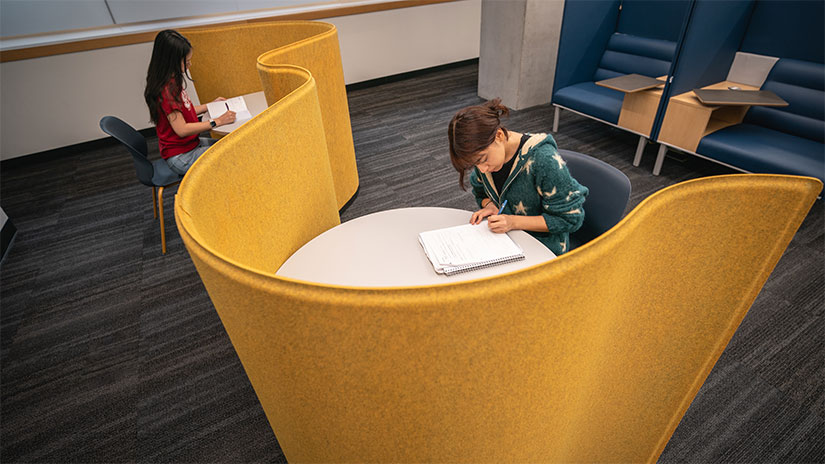
Students seeking a bit more privacy would do well to explore the Library’s other floors, where a range of single-user study pods await. On the lower level, blue-and-gray workstations offer more desk space for your books and laptop. On the fifth level, small tables nestle behind tall, undulating privacy panels in upholstered gold, making them an ideal spot for getting away from the world for an afternoon of deep studying.
Soundproof and private
And if you really need to tune out all distractions, you can reserve one of the Library’s “phone booths,” free-standing modules offering 13 square feet of blissful soundproof silence. Each one features all the creature comforts of your own private workstation, including a desk, soundproof walls, power outlets, and ventilation.
Rachel Liot, a student worker at the Library, notes that the booths have become very
popular due to their versatility. “Some people reserve the study booths because they
need to focus,” Liot explains. “Other times, it’s because they have an online class,
so they need to speak
and engage in conversation.”
“It’s made such a big difference,” adds Butler of the new layout. “Even new students who have no idea what the original layout was are gravitating toward those newer areas, which is great to see.”
 Collaborative and interactive
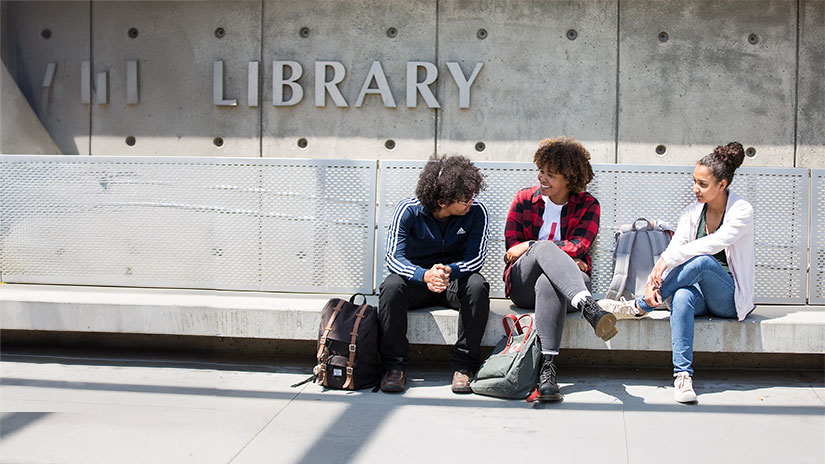
To balance out the quiet spaces for individual studying, Butler and the Library team also made sure that there were ample opportunities for students to socialize, whether it be in food-friendly silent zones where they can study together, or inside glass-paneled study rooms for more interactive learning. Wayfinding signage coupled with the appropriate furniture helps students easily identify the spaces that work best for them, says Cruz.
“We see students interacting more, collaborating more nowadays,” she explains. “So
creating the spaces for that, along with the signage, promotes those interactions,
while helping students self-regulate noise levels based on
the zone.”
Cruz adds that the creation of designated quiet study spaces with privacy and noise-reducing features provided the added benefit of freeing up more private study rooms for group use.
Support and more
It isn’t just the physical space that’s undergone a transformation. In recent years, Butler and his team have also been busy making sure that the Library is responsive to the evolving needs of students. One such welcome innovation is the creation of a Textbook Commons where students can access costly print textbooks and eTextbooks required in their classes.
“Before Walter, we had to count on faculty to offer us a copy of a textbook when they could,” Owlya says. “Now we can buy them ourselves. That’s such a huge difference for students.”
The Library is also working to address students’ pain points in other ways. Forgot
your laptop or phone charger at home? Just drop by the service desk, where one of
the helpful Library staff will assist you in checking out one of the bright yellow
charging kits. For students without a laptop, more than 215 computer workstations
are available throughout the Library; several Chromebooks
are also available for short-term loans.
The Library’s work goes beyond just supporting students in achieving their academic
goals. Given the prevalence of stress and burnout among college students today, Library
faculty and staff have also been working to foster mental health and wellness in different
ways. During finals, the librarians set up a table where students can take a much-needed
study break and lose themselves in puzzles, coloring books, and Legos. There are also
librarian-hosted coffee socials and other activities throughout the academic year
to foster
a sense of connection and belonging.
Enriched programming
Beyond meeting students’ most immediate needs, the Library also offers additional programming that deepens and enriches the library experience for everyone. One popular activity is Pearls and Insights, a virtual author-talk series featuring authors like Shadow and Bone series writer Leigh Bardo and Nobel Peace Prize winner Malala Lousatza. Beyond the Library walls, staff have also held pop-up workshops at satellite campuses, covering topics such as digital safety and research assistance.
“I love these kids,” Owlya says. “I love interacting with them. And I think they like to have that connection, to feel like they’re in a safe space. So I think we’re all trying to just be there for them and make the Library a good space for them.”
The renovation, coupled with the innovations in services and programming have yielded promising results, starting with a marked uptick in visitors. Butler mentions that according to records, the Library saw a 50% increase in foot traffic during the first week of the Fall semester, compared to the previous Fall semester. Although the numbers tapered down in subsequent weeks — as is usually the case throughout the semester — Butler notes that student use of the Library remains high compared to previous semesters.
“We all see it and feel it,” he adds. “Students are claiming spaces. They’re filling the Library. It’s so amazing to see.”
 Thoughtful design
The increase in numbers is likely due to another, more subtle change: The Library now feels like a place you want to be in. Much of that is due to the thoughtful consideration that went into furniture selection and delineation of zones for specific activities, as well as the thoughtful decision to give study areas room to breathe. Instead of cramming the maximum number of seats into the commons, for example, the renovated work area now emphasizes a generous amount of space between workstations.
With the increase in foot traffic, one might think that the Library was at risk of bringing back the cafeteria-level noise of the past. But with new furniture and zoning that emphasize quiet, focused study came a decrease in seating density in these areas. That may affect how students are interacting with the library as a physical space, says Butler.
“For the most part, students are very quiet in the Library,” he says. “It’s almost like they’re picking up on all of these cues and responding to them. It’s an amazing thing to see, especially given the increase in students who visit.”
A sense of belonging
For the longest time, students could find this sort of oasis in the library. For most of the 20th century, libraries were spaces for quiet study and self-education. But by the late 1990s, the idea of libraries were had evolved, transforming from quiet reading rooms to lively learning commons where people could connect, collaborate, and create.
That learning commons model was already well established by the time Santa Monica College began a major renovation of its own Library Building. Following the 1994 Northridge earthquake, SMC invested more than $20 million toward a substantial overhaul of the existing structure. In 2010, the new SMC Library was unveiled. With space for more than 1,300 students, the award-winning structure boasted an open space interior with multiple floors, a variety of seating arrangements and study areas, and 19 group study rooms. And while it became a popular gathering spot for students, it also suffered from excessive noise — a common complaint about learning commons libraries.
It’s a fine balance between being with others and being on your own. One recent study found that many students don’t use the library as a space to socialize per se, but they do benefit from a sense of belonging when around other people, even when people are studying on their own. The same study also emphasized that spaces for individual study with low social interaction remain a high priority for students. Those two considerations are consistent with what Library Chair Roxana Cruz has been hearing from students.
“The Library serves many different purposes for different students,” she says. “Many of them were telling me that they couldn’t focus while at home. What they were looking for was a quiet space of their own. We realized that we needed a Library that reflects that and caters to their needs.”
Looking ahead
Libraries will continue to evolve. There will always be new technologies to adopt and innovative approaches to consider. Establishing open access to academic research, creating maker spaces, employing AI in curating collections — the possibilities are endless.
And while the SMC Library continues to focus on the needs of students in the here and now, the team is also looking ahead to what else can be done to improve the library experience. Butler, for instance, is mulling over the idea of opening up the Library to the outdoors.
“We have patios attached to the library,” he explains, “but they’re currently not open to students. If we could open up that area to them and get it properly furnished, students would be able to eat and study outside.”
Change is inevitable. But two things will remain constant at the SMC Library: the team’s unwavering affection toward the students who walk through their doors, and their commitment to making sure everyone feels at home.
“One of my favorite things is introducing someone to the Library,” shares Cruz. “I like to show them the lay of the land — here’s the reference desk, here are the different spaces, over there are the private study booths.
“And then I make sure to tell them: This is your library. Go ahead and explore it!”