


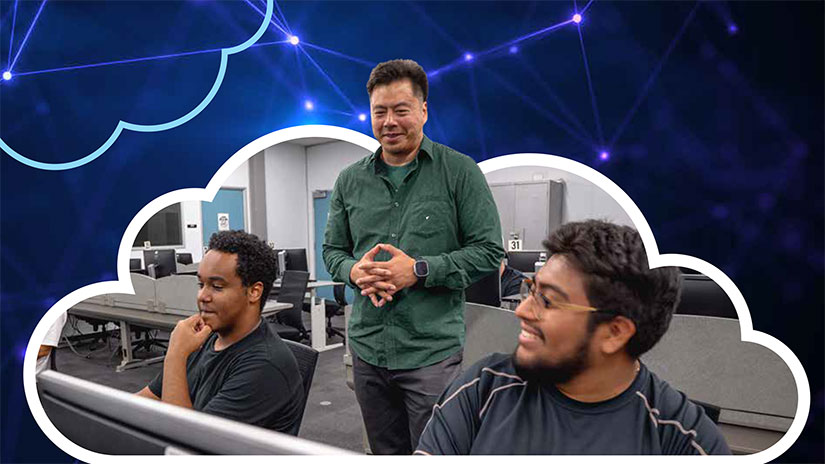
A highly affordable upper and lower division pathway for students into in-demand jobs with competitive salaries.
Some kinds of education feed your passion. Others build your career. And occasionally, there’s the kind that does both.
Just ask M.J. Anselmo. Now a systems engineer working for an IT services firm, the Santa Monica local first got hooked on technology while taking part in a Santa Monica College program where high school students could enroll in college-level classes.
“I accidentally fell in love with what my professors were teaching,” he says. “That kickstarted a side passion for more.”
That passion led Anselmo to earn his Associate degree in cloud computing at SMC. It was an eye-opening experience that gave him plenty of hands-on learning opportunities, including creating a private cloud for his family. His labor of love saw Anselmo transferring his parents’ not-insubstantial collection of CDs and Blu-ray discs onto several recycled computers and connecting them all to the internet.
“Now my dad can listen to all of his music while he’s on the go,” says Anselmo. “We can also get together and watch his old movies anywhere he wants.”
That real-life application of everything he’d learned in the program—coupled with the realization that cloud computing was going to play a big role in building the future—played a major part in Anselmo’s decision to return to college and enroll in SMC’s new program leading to a Bachelor’s degree in Cloud Computing. Slated to begin this fall, the four-year program will build on the current lower-division cloud computing curriculum that Anselmo completed.
“Not having a Bachelor’s degree holds people back a little bit,” Anselmo shares. “So this will really help people like me progress into management roles.”
A 2026 report from the Bureau of Labor Statistics indicates that the information sector is on track to become the third-fastest-growing sector of the economy.1 One of the major drivers of that growth has been cloud computing. Once the new kid on the technology block, cloud services have become the go-to option for online retailers, streaming services, banks, and more.
In the past, selling merchandise or offering services online required a company to have its own computer servers. It was a slow, costly, and painful undertaking for any business that just wanted to focus on selling shoes or providing a streaming service.
“To provision a server, we’ve got to have power, cabling, air conditioning, a clean room, a locked space,” explains Howard Stahl, chair of SMC’s Computer Science and Information Systems (CSIS) Department. “We’ve got to requisition it, put the operating system on it, turn it on. All that friction takes months, whereas nowadays, you can go to a cloud service provider and turn on a server, just like that.”
But cloud infrastructure needs skilled professionals—and lots of them. Over the last 20-odd years, cloud computing occupations have grown more than 41 percent in Los Angeles County, says Jason Beardsley, SMC’s Vice President of Academic Affairs. Current estimates now place annual job openings at more than 2,700.2
“This is a fast-growing field with strong wages and lots of good jobs available,” he says. “Employers are out there looking for candidates with Bachelor’s degrees.”
“This is a fast-growing field with strong wages and lots of good jobs available. Employers are out there looking for candidates with Bachelor’s degrees.”
That’s why the community college Bachelor’s degree is a real game changer. Until 2014, California law limited community colleges to academic and vocational instruction in the first two years of college. They could award Associate degrees, but Bachelor’s degrees were strictly off-limits. But the rising cost of higher education, coupled with the need for more skilled workers in various fields, prompted California to launch an innovative pilot that allowed SMC and 14 other community colleges to offer a Bachelor’s degree in a specific field for the first time.
In 2015, SMC unveiled its first four-year degree, a Bachelor’s degree in Interaction Design (IxD), with a program featuring courses in product design, web development, and marketing. The first cohort started in fall 2016, and the program is now in its 11th year, having graduated more than 160 students. Many of them have gone on to work at major tech companies such as Meta and Google.3
For its second Bachelor’s degree program, SMC didn’t have to look too far for ideas. Back in 2014, Stahl had already begun collaborating with Amazon Web Services (AWS) to create a cloud computing certificate program that would introduce students to AWS and other cloud technologies, while serving as a primer to cloud careers.
“We initially built this four-class sequence and just tried it out,” recalls Stahl. “And what we heard from the students was that they wanted more experience, so we built a fifth class. So the program we constructed was a result of responding to both employer needs and student needs.”
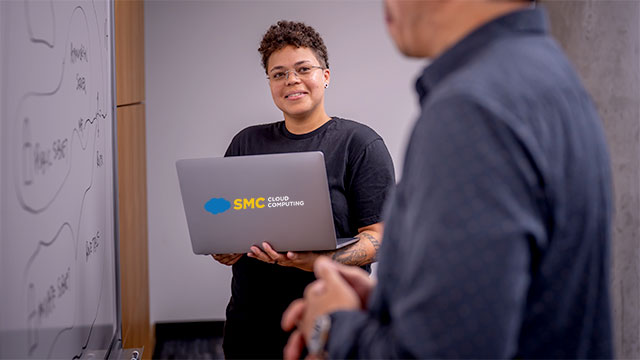 The program combines practical cloud and AI training with critical thinking, collaborative
problem-solving, and hands-on capstone experiences.
The resulting program was so popular that the California Community Colleges Chancellor’s
Office provided SMC with funding to establish a regional partnership to promote greater
regional employer involvement and the sharing of open-source curriculum.4
“We’ve been running this program for more than 10 years now,” Stahl says with pride.
“We built a community of practice around cloud computing education, with as many as
19 other colleges running our same classes.”
That decade-long experience in teaching the program and building a regional partnership, coupled with a direct line to AWS, made SMC the natural home for a new degree in cloud computing. That degree is especially important for the workforce today, explains Valerie Singer, general manager of global education at AWS.
“Cloud and AI expertise rank among the most sought-after skills in today’s workforce,” she says, “but technical skills alone aren’t enough. Programs like Santa Monica College’s Bachelor’s in Cloud Computing are essential because they combine practical cloud and AI training with critical thinking, collaborative problem-solving, and hands-on capstone experiences, preparing graduates with the complete skill set employers actually need across industries.”
To further enhance the value of the Bachelor’s degree, SMC built on the existing program by stacking progressive tiers of certification: While the Associate degree focuses on an intermediate credential for core cloud design, the Bachelor’s degree prepares students for a professional exam that earns them an advanced credential for enterprise-scale systems.
“There’s a Department Certificate, a Certificate of Achievement, and an Associate degree,” says Dr. Steven Sedky, SMC’s interim associate dean of Career Technical Education. “And now, we have a Bachelor’s.”
That Bachelor’s degree is also the best bang for your education buck. For California residents, tuition is estimated at $10,000 for the full four years—a far cry from the cost at traditional four-year institutions, which can run upwards of $29,000 for a single year.
Stahl adds that some students could pay a lot less. “It’s two years of an Associate degree, and then the Bachelor’s degree is two more,” he points out. “If you’re arriving at SMC with 60 units, you’re going to be spending a lot less to get this degree.”
There are other ways to save, of course. SMC also offers financial aid and scholarships. And for high school seniors who meet the requirements, Sedky says, the cost of the first two years of college would be covered by the California Promise Program.
“When you look at the ROI for tech careers, it’s the best value in higher education,” he says.
Providing that ROI to students has always been a priority at SMC. Sedky notes that the idea for a Bachelor’s degree in cloud computing was driven by the College’s ongoing quest to create and offer programs that are relevant, not just in terms of workforce demands, but also the quality of life for students, many of whom are the first in their family to attend college. The Bachelor’s program was also designed to be flexible, meeting the needs of both recent high school graduates and working adults returning to school.
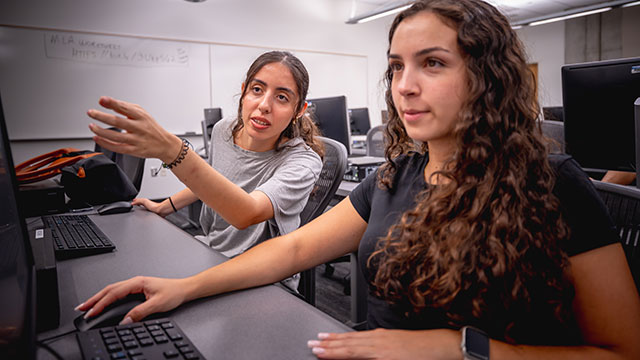 The low-cost program has online and in-person options available. Upper division classes
begin Fall 2027.
“We always want to focus on providing economic and social mobility,” says Sedky. “Particularly with a Bachelor’s degree in the tech space, where wages are high.”
“When you have a community college student with an Associate degree who’s trying to get a job in tech, and they’re competing with a graduate from a four-year university with a degree in computer science,” Stahl adds, “it’s not exactly an even playing field.”
That’s why SMC’s new four-year degree is great news, says Kai Shimoda, an alum of the SMC cloud computing program who now works as a software engineer for a local government agency. The degree changes the game for community college students seeking to advance in the tech sector.
“The main appeal of going to a four-year university was to get a work position,” Shimoda explains. “But with how things are right now, that’s not guaranteed. Being able to secure something now, something that’s already in the field I’m working toward, is more beneficial in my eyes.”
Anselmo agrees.
“To be honest, I’d given up on the traditional schooling system,” he confesses. “I’d always wanted a Bachelor’s degree, but I just couldn’t see myself pursuing one. I didn’t have the time to go back to school full time at a traditional fouryear. So I put school on the back burner.
“But now, this cloud computing degree is like a green light,” he says. “I’m really excited. I feel like SMC is taking a brand-new approach that’s long overdue.”
Technology never stands still. It’s always changing, always reinventing itself, and with it, society. That’s why SMC is already looking beyond the horizon, trying to get a glimmer of what’s to come. And along with that, figuring out new ways to best support students as they face an ever-changing labor market.
“AI is a big part of the workflow in the cloud computing space,” Sedky points out by way of example. “That’s why we’re looking at updating the curriculum to embed AI training, so that students are ready for what’s coming.”
Similar to how they expanded the initial cloud computing certificate program into a regional collaboration, Stahl and the rest of the CSIS Department faculty are now exploring ways to promote increased access to the degree. Along with an on-ground cohort, they’re planning a fully online cohort, which would make it possible for any resident in California to earn the degree. Whether it runs depends on how many students apply.
“We’re thinking about a cohort that would run on ground,” Stahl says. “And then we’re also thinking about the cohort that would run all online. That way, we can recruit from across the state and really grow the program.”
An online option would be amazing, says Beatriz Galarza, who’s slated to graduate with the Associate degree in Cloud Computing this semester, but has already decided she’ll be applying for the Bachelor’s program. After her first year at SMC, she moved to Carlsbad, California, and now drives to attend classes on campus twice a week. Her commute takes anywhere from 90 minutes to two hours.
“I’m hoping it’s a little bit of both,” she says of in-person and online classes. “I enjoy going to school and seeing people. But I also appreciate not having to wake up early.”
Ready to apply? Applications for the Bachelor of Science in Cloud Computing are still being accepted. Students who apply by the priority deadline of January 15, 2027, will be in the first round of review; the final deadline is March 1, 2027. Admission decisions are expected in mid-March, and the first cohort starts in fall 2027.