
February 20, 2026
Santa Monica College Planetarium Shows Explore the Spring Skies
Santa Monica College Planetarium Shows Explore the Spring Skies, Explain the Spring Equinox, and Take a Look at the Life Cycle of Stars
March Lineup Includes Sunday Family Matinée Presentations
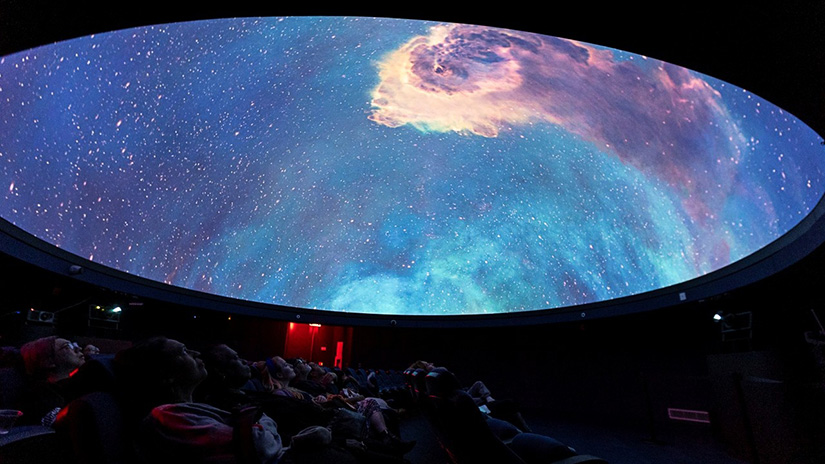
SANTA MONICA, CA — The Santa Monica College Planetarium will present live-hosted, on-campus shows on Friday evenings and Sunday afternoons in March. The March shows include the popular weekly update “The Night Sky Show,” a Feature Program about the seasonal objects in the spring sky, a Feature Program that explains the spring equinox, and a Feature Program presenting an in-depth look at the life cycle of stars. Each show is about 40 minutes long and followed by a short audience Q&A with Planetarium Lecturer Sarah Vincent.
Friday evening shows start at 6 p.m. with “The Night Sky Show,” presenting the latest news in astronomy, space exploration, and the night-sky celebrities making their appearance in the evenings ahead. The show is followed at 7 p.m. by a Feature Program. No children under age 3 permitted at the Friday shows.
Sunday Family Matinée shows start at 1 p.m. with “The Night Sky Show,” followed at 2 p.m. by a Feature Program.
All shows are presented in the SMC Planetarium, located in room MSB 126 of the Mathematics + Science Building on the SMC Main Campus at 1900 Pico Blvd., Santa Monica. Ample and conveniently located free parking for planetarium shows is available on the SMC Main Campus at 1900 Pico Blvd.
Tickets may be purchased at smc.edu/tickets (a $1 per ticket service fee will be charged by the ticketing company). PLEASE NOTE: No children under age 3 at Friday evening shows.
THE NIGHT SKY SHOW: $10 adults, $7 children ages 3-12
FEATURE PROGRAM: $10 adults, $7 children ages 3-12
SHOW COMBO (“The Night Sky Show” plus Feature Program): $16 adults, $10 children ages 3-12
The March 2026 shows are:
- “The Night Sky Show” — Using SMC’s 4K Digistar projection system, Planetarium Lecturer Sarah Vincent will talk about the latest news in astronomy and space exploration, and present a virtual tour of constellations and other night-sky celebrities making their appearance in the evenings ahead. Sunday, March 1, 1 p.m.; Friday, March 13, 6 p.m.; Sunday, March 15, 1 p.m.; Friday, March 20, 6 p.m.; Sunday, March 22, 1 p.m.; Friday, March 27, 6 p.m.; Sunday, March 29, 1 p.m.
- Feature Program: Deep Sky Deep Dive: “Black Holes” — Black holes are some of the most fascinating, yet least understood phenomena in the universe. Many are dead stars shrouded in gravity, yet others form the cores of large galaxies. This show explores these singularly enigmatic objects first predicted by Einstein’s Theory of Relativity and finally confirmed decades later. Sunday, March 1, 2 p.m.
- Feature Program: “Spring Sky” — As the Northern Hemisphere slips into spring, some familiar constellations move overhead. Cygnus flies along the Milky Way toward Sagittarius and the core of the Milky Way. This show explores the planets, constellations, and deep sky objects making their seasonal appearance in Santa Monica’s spring skies. Friday, March 13, 7 p.m.; Sunday, March 15, 2 p.m.
- Feature Program: “Tilt: March Equinox” — The changing season brings warmer weather and shorter nights for the Northern Hemisphere, but why? How does Earth’s axial tilt change the weather? Do any other planets in the solar system have seasons? This show explores Earth’s equinox. Friday, March 20, 7 p.m.; Sunday, March 22, 2 p.m.
- Feature Program: Deep Sky Deep Dive: “The Life and Death of Stars” — This solar system’s star, the Sun, is a typical star, but what does that mean? What is an a-typical star? Where do stars come from, and how do they end? This show explores the life cycle of stars from nebula to (super)nova, and back again. Friday, March 27, 7 p.m.; Sunday, March 29, 2 p.m.
More information is available online at smc.edu/planetarium or by calling 310-434-4163. All shows subject to change or cancellation without notice. Santa Monica College is a California Community College accredited by the Accrediting Commission for Community and Junior Colleges (ACCJC).
###