





Albert Einstein is staring at you.
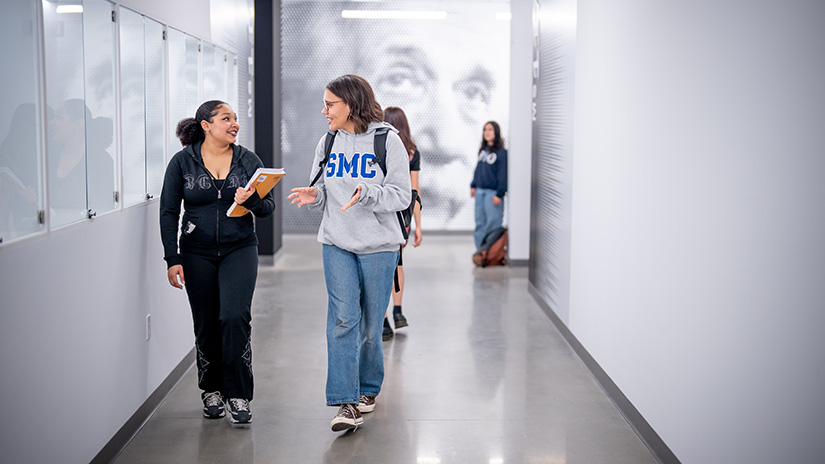
Well, maybe not exactly at you. The man’s eyes are fixed on something just over your shoulder, like he’s spotted some quirk of spacetime. And, of course, it’s not really Einstein, but a larger-than-life representation, a constellation of halftone dots filling the entirety of the wall at the end of the hallway you’re standing in.
You draw closer to the image and notice the quote on the wall beside him: Curiosity is its own reason for existing.
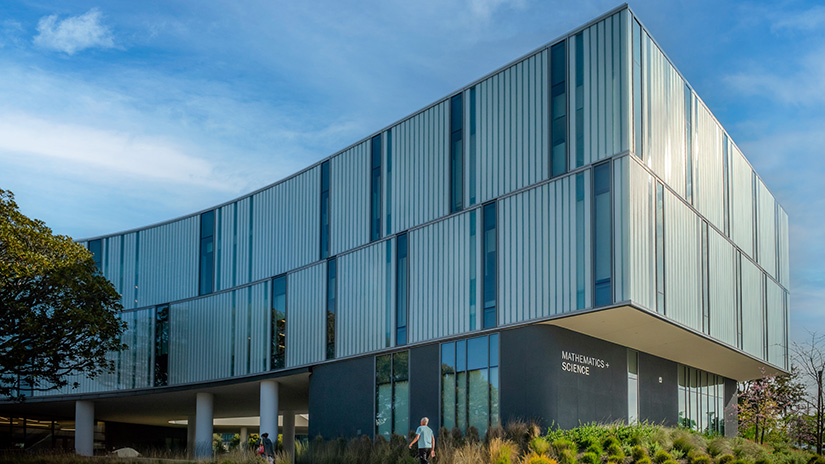
That boundless sense of curiosity—of discovery and exploration—exists throughout Santa Monica College’s newly completed Math and Science Building. Measuring about 111,000 square feet, the facility offers plenty of space for four SMC departments whose courses are perpetually in high demand. This convergence of disciplines under one roof is intended to spark interdisciplinary collaboration among faculty while promoting better learning outcomes for students.
Architecture for Exploration
Santa Monica College has long enjoyed a stellar reputation for its science and allied health programs. In recent years, however, the College’s ability to meet the growing student demand was nearing its limit, particularly with lab spaces heavily booked every semester, leaving little room to accommodate additional course sections.
That’s made it particularly difficult for departments like Mathematics and the Earth, Physical, and Life Sciences, which were growing well beyond their existing accommodations. In addition to more space, updated equipment for instruction was needed.
“Science evolves,” says Jason Beardsley, SMC vice president of Academic Affairs. “There are always new technologies and new techniques that students must learn and master to be ready for the future. That’s why it was important for SMC not just to create new spaces, but also embed into those spaces the tools and resources needed to ensure students thrive.”
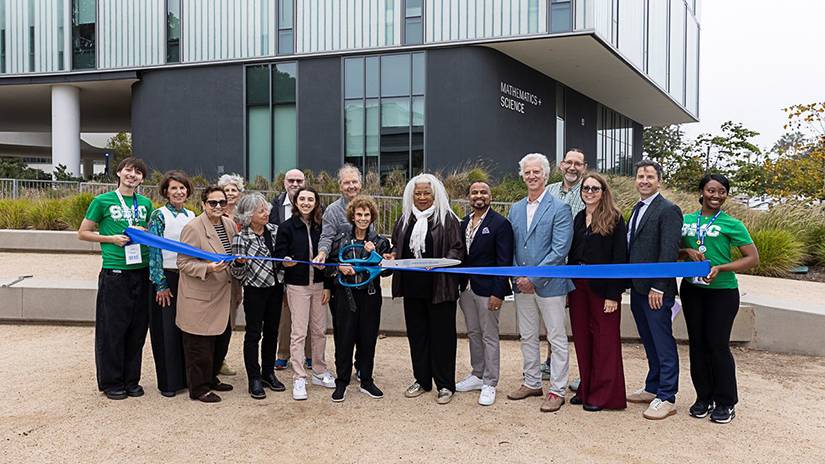
In 2019, initial planning began for the creation of a new facility that would meet these needs. In addition to providing new space and a host of modern resources, the building would also serve to build out SMC’s extensive math and science ecosystem that was anchored by Drescher Hall, the Math Complex, and the Science Building. With extensive feedback from faculty and other stakeholders, SMC partnered with architecture firm CannonDesign—known for innovative projects such as the Johns Hopkins University Applied Physics Laboratory and Caltech’s Resnick Sustainability Center—to bring this vision to life. With the generous support of the Santa Monica and Malibu communities via a local bond measure, construction on the new building began in 2022 and was completed in late 2024.
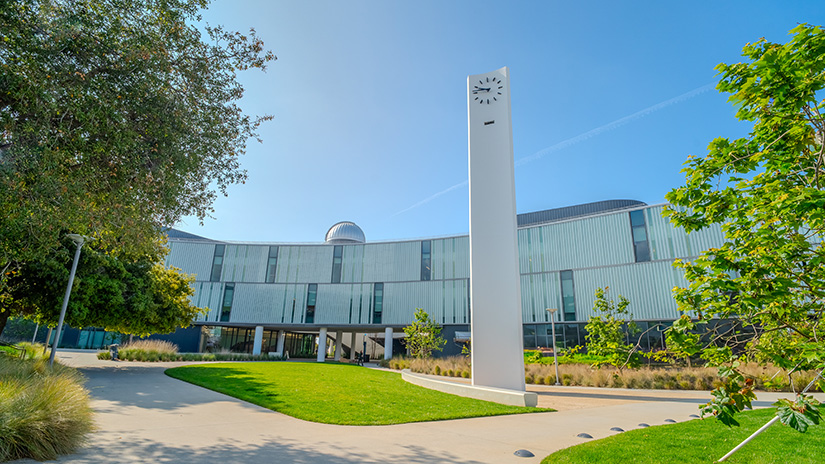
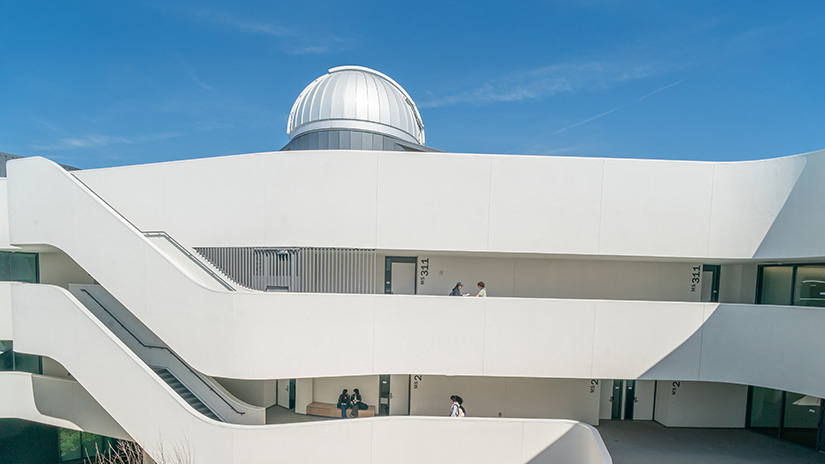
Standing on the southeast corner of the campus, SMC’s new Math and Science Building is a multi-storied marvel of design and engineering. Three wings radiate gently outward from an open-air atrium, where pedestrian pathways slip orbit-like past the outdoor stairway. Tiered seating runs alongside the stairs, serving as a mini-amphitheater for outdoor learning.
The design of the building is a subtle nod to SMC’s vision of what an evolving education must be—reaching ever outward to the future from a shared center, yet still connected to the past. A lone bridge walkway, perched high above the ground, connects the new building to the existing Science Building. Two of the new building’s wings arc gently toward the College’s venerable Clock Tower, as if embracing everything that has come before. Little wonder that the LEED-certified Gold building has already nabbed a design award from the Los Angeles Business Council.
Once inside, you get a clearer sense that the building represents not just an extension outward into the world, but a coming together of disciplines. Over there is a mural of Stephen Hawking reflecting on the unquenchable need to understand the universe. In another hallway, string theory physicist Michio Kaku ponders the mysteries of the human brain. Not far away, mathematician Katherine Johnson recounts computing a path to the moon.
There are other residents, of course. The building serves as the permanent home for two departments—Earth Sciences and Mathematics—while also offering some much-needed expansion for two others—Life Sciences and Physical Sciences. With this in mind, the building features 22 cutting-edge classrooms, 11 labs, Math Lab and Computer Lab areas, and numerous faculty offices. Interspersed throughout the building are areas where students and faculty members can study, collaborate, or just hang out.
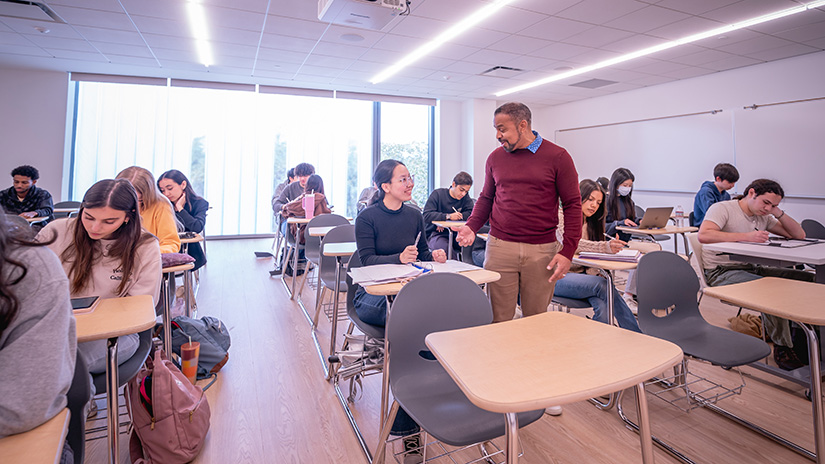
In creating the new space, CannonDesign incorporated a constellation of features, both big and small, that come together to create a learning experience that is greater than the sum of its parts. For instance, classrooms come equipped with document cameras that professors use to project printed materials or real-time experiments onto a high-definition monitor that offers students a clear view.
And then, there’s the light. Channel glass, translucent and lightweight, envelops the building, allowing natural light to fill the hallways and classrooms. The result, says Physical Sciences Chair Jennifer Hsieh, is a profusion of spaces that feel fresh and open.
“Every person that I brought into these new rooms, the reaction was just, Wow.” Jennifer grins. “That reaction — that’s when you can tell something is really special.”
The new building serves as the new home for the Mathematics Department, one of SMC’s largest academic programs. In fact, demand for math courses has ballooned over the years, says Department Chair Colleen McGraw.
“We had classrooms in different buildings throughout the campus,” explains Colleen. “That was definitely less than ideal. And they weren’t uniform in size, with some being quite a bit smaller than others.”
With the new Math and Science Building, most of the department’s assigned classrooms and faculty offices are now under one roof, ensuring students have more opportunities to drop by for consultation during office hours. That proximity to math classrooms also makes it a breeze to hunker down and get some serious studying done in the brand-new Math Lab or one of its adjacent study rooms. In addition to an ever-present math lab staff on hand to assist students, it’s not uncommon to find a faculty member there, talking students through a particularly thorny math problem or geometry proof.
That is one of the definite advantages of having a centralized space, Colleen notes, as she points to the profusion of photographs, posters and sketches that adorn the hallway window of a nearby workshop room.
“We can create a community here,” she says. “A place where we can truly foster a collaborative learning environment, with the Math Lab as the centralized hub for learning and community building.”
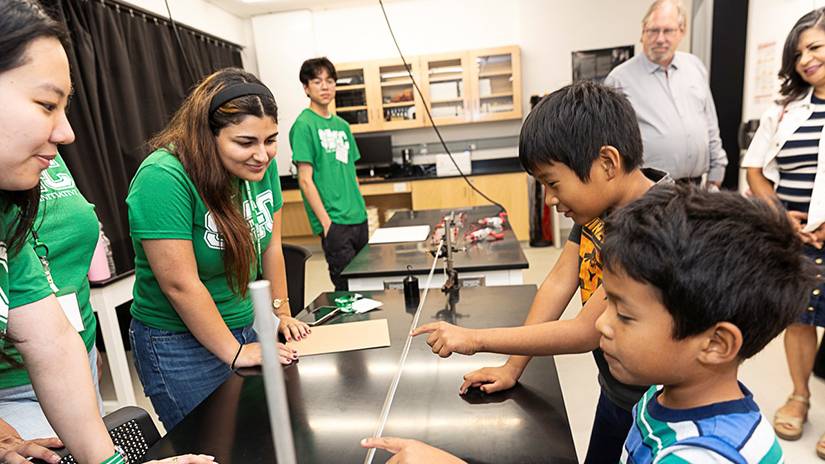
For the Physical Sciences Department, the new building offers much-needed room to grow. Encompassing three major disciplines — Chemistry, Engineering and Physics — with classes that are in high demand, the department needed not just space but up-to-date equipment.
To meet the department’s needs, the new building offers a fully equipped Organic Chemistry Laboratory and a Physics-Optics Lab, both with dedicated stockrooms, as well as new faculty offices. The new facilities come at just the right time, says Jennifer, noting that the department has been working to keep up with students’ evolving needs.
“With this expansion, we now have the ability to offer more sections of Physics than we could before,” she adds.
The new building also offers new space for the Life Sciences Department, which incorporates Aquaculture, Biotechnology, Environmental Science, General Science, and Nutrition and Dietetics. With such a diverse range of disciplines, class locations have been assigned by necessity, not just in different buildings, but at different locations. But more space was needed.
“We’d reached our capacity in terms of office, classroom and laboratory space,” says Life Sciences Chair Garen Baghdasarian. “The new building comes as a relief to our heavily burdened portion of the existing Science Building.” He adds that faculty will have just started holding classes and labs during the Fall semester in the new building, which comes with dedicated labs for Anatomy and Molecular Genetics on the second floor.
Appropriately enough, the Earth Sciences Department — with disciplines ranging from Geography and Geology to Anthropology and Astronomy — occupies the new building from top to bottom. In addition to the planetarium and four dedicated labs at the ground level, the Astronomy and Geology labs inhabit the third floor, while the observatory sits loftily above it all.
Earth Sciences Chair Eric Minzenberg explains how the building’s overall design — from the increased size of the rooms and the layout of tables to the reconfigured prep and storage areas — makes a profound difference in both the learning and teaching experience.
“This new building gives us plenty of opportunities to enhance instruction for students in the multiple disciplines that we teach,” he says. “Everything is optimized here in terms of the technology and features that students and faculty need.”
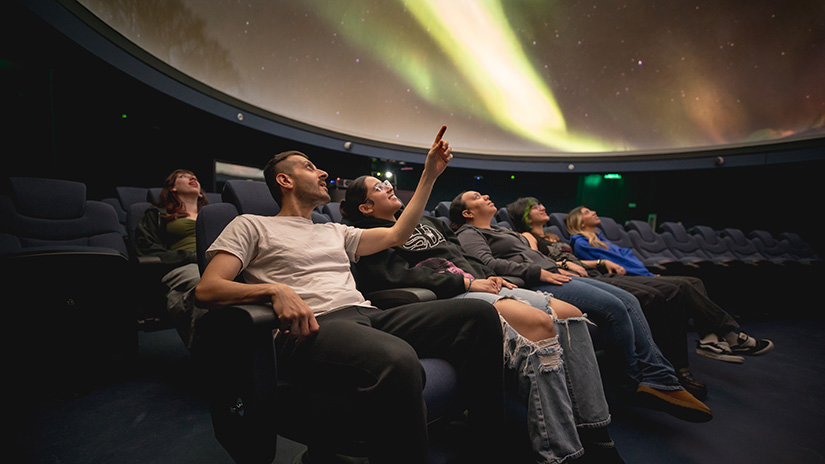
Yet for the department’s Astronomy staff, no other aspect of the building is quite as exciting as the planetarium and observatory. Astronomy Professor Simon Balm points out that the new 56-seat planetarium features a best-in-class Digistar 7 digital projection system, a newer model similar to the one at Griffith Observatory, that will transform the planetarium experience with high-definition visuals and immersive simulations of the night sky.
“This is a major upgrade from the old system,” Simon explains. “With this, SMC now has one of the most advanced planetariums in Los Angeles County.”
Even better, the Digistar 7 system, once fully online, will connect Santa Monica College to a global network of other Digistar-equipped planetariums - from NASA and NOAA to numerous universities - that share resources and presentations with each other. SMC will have real-time access to more than 1,700 presentation items for use in classes or for public shows.
“We now have the capability to run live shows on the fly,” planetarium lecturer Sarah Vincent excitedly explains. “We can pull up different assets and put them together for a show. We can run presentations, host guest lecturers, even stream a live telescope feed from the dome.”
That dome, located on the rooftop, houses SMC’s new observatory, with a 28” (0.7 m) Planewave CDK700 telescope that gives exquisite views of the Moon and planets as well as more distant stars, nebulae and galaxies. Capable not only of visual observation but electronic imaging, the telescope can be accessed via smartphone or tablet.
“Having access to state-of-the-art equipment like this will give students valuable opportunities to engage in research work,” Simon says.
Space for the Community
The new opportunities aren’t just for students. From the beginning, the building was always meant to be a space shared with the community. Simon and Sarah are already mapping out activities that make the most of the new observatory and planetarium. Past events at the old planetarium, focusing on everything from kid-friendly star tours to the Apollo program were a big hit with audiences. Now, with the new technology, the sky’s not the limit — It’s just the beginning.
“I want to make sure that we get the word out that SMC has a state-of-the-art planetarium facility,” says Sarah. “ We want everyone to know that they’ve got this thriving college right in their backyard. And that this place is theirs.”
Like all the best learning spaces, the Math and Science Building represents a multitude of different things for different people. It is a new home, a much-needed expansion, a place for collaboration and creativity, a solution to other challenges. It’s a place to dream and explore, to look deep into our world and to look up and out at the night sky.
It is space. But it is also time.
“This building will be here for decades,” Eric says. “It will outlast many of us. And that’s a beautiful thing to consider. That all of us working together — the College and the community — we created a legacy that will endure and thrive. I’m extremely grateful for that.”
As the sun begins to dip toward the west, you gravitate back to the planetarium to visit one more wall installation: Mae Jemison, the first woman of color to travel to outer space. Here, in this newly minted inner space, her words take on extra meaning.
Never limit yourself because of others’ limited imagination.
* * *
[The original version of this article appeared in the Fall 2025 SMC Schedule of Classes]
SMC in Focus Volume XI, Issue 6
Jazz Building Blocks
A team of SMC architecture and interior architectural design majors recently earned national recognition with a design inspired by Kansas City’s deep roots in jazz and blues. Read Article

Toward Zero
Santa Monica College’s award-winning Sustainable Materials Management program turns zero waste principles into healthier surroundings — and successful careers. Read Article

From WongCo to WongCuts
An IT staffer is preparing for life’s next chapter—and fulfilling a long-buried aspiration—as a student in SMC’s nascent Barbering Program. Read Article

Sense of Belonging
SMC’s Student Equity Center builds community, supports identity and creates space for students to grow, lead and take pride in who they are. Read Article

Bragging Rights
Black Collegians Umoja wins two statewide awards. SMC accounting alum garner scholarships. A Music instructor performs at Harvest Moon Gathering. Read Article
A Hub for Discovery
SMC’s new Math & Science Building brings together four academic departments and a world-class planetarium + observatory, offering new opportunities for discovery and exploration. Read Article