

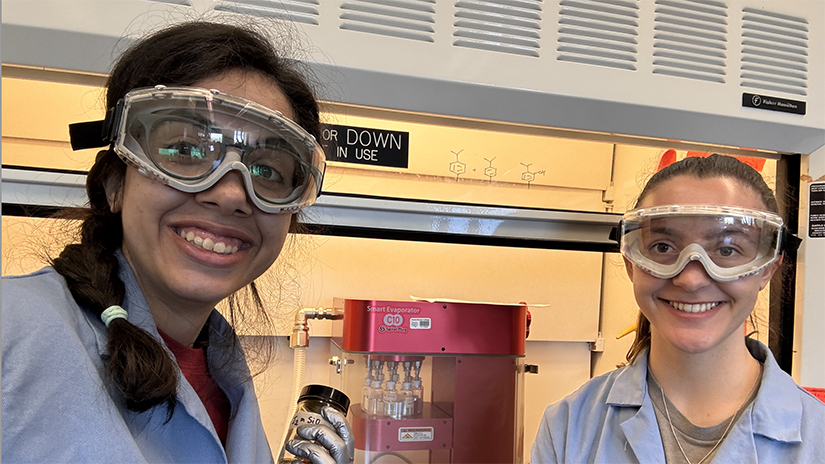
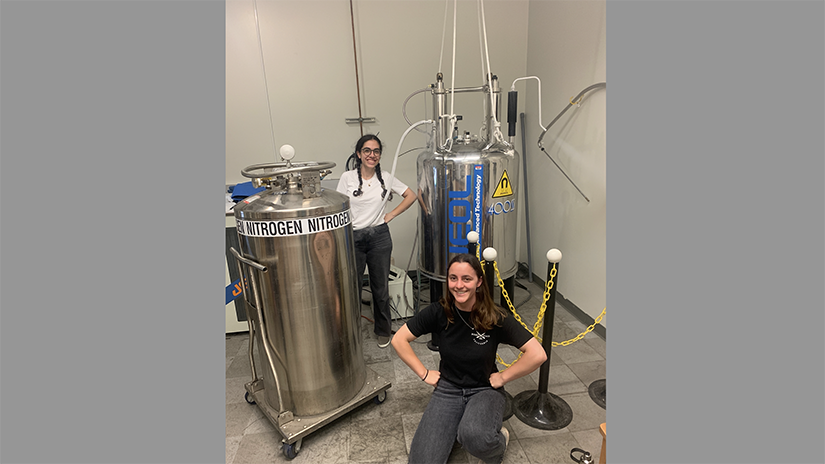
Ghazal's NMR Independent Studies class at SMC
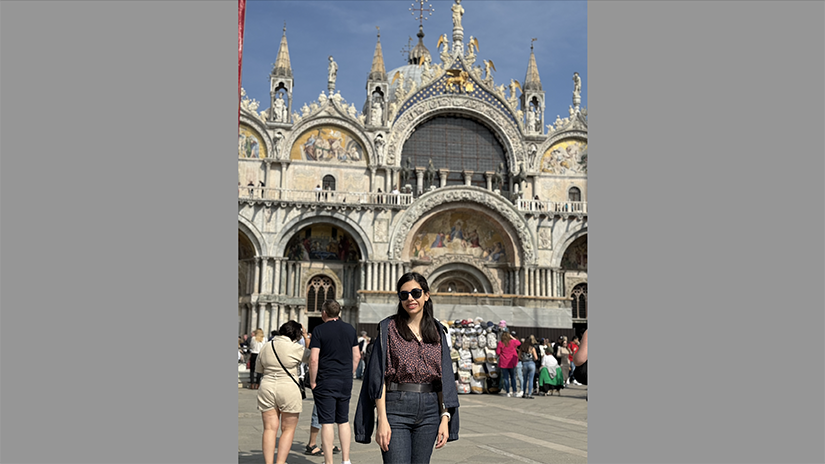
Ghazal on vacation in Venice, Italy
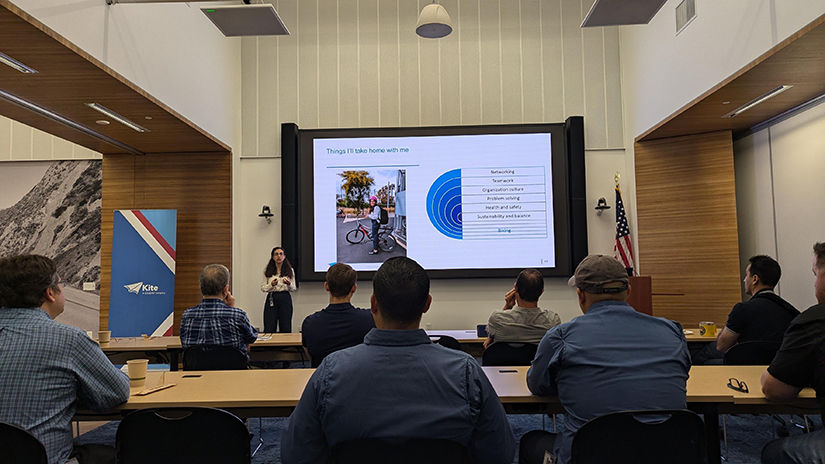
Ghazal's final presentation at Kite
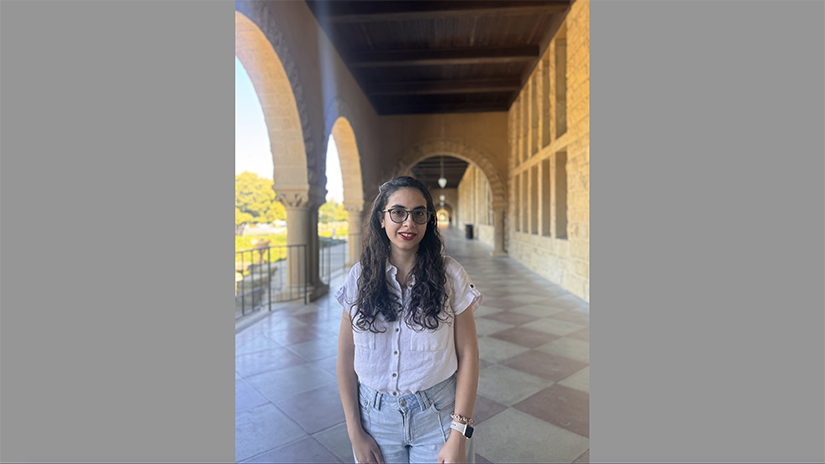
Ghazal on her first visit to Stanford
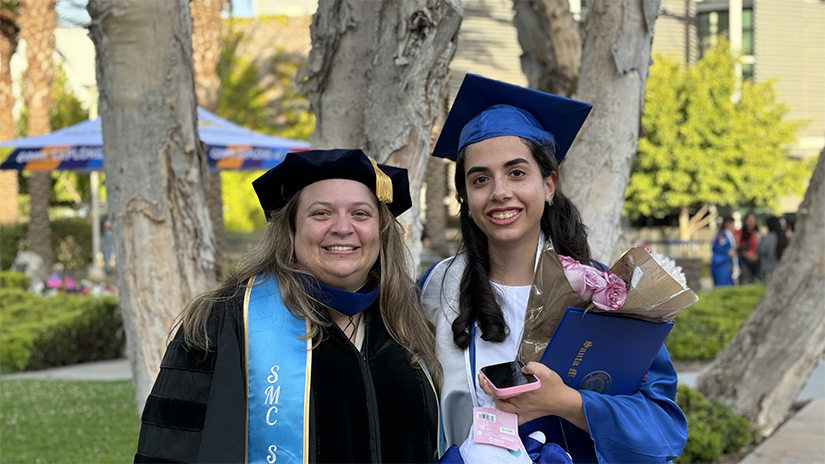
On SMC Graduation Day with Prof. Susan Baker
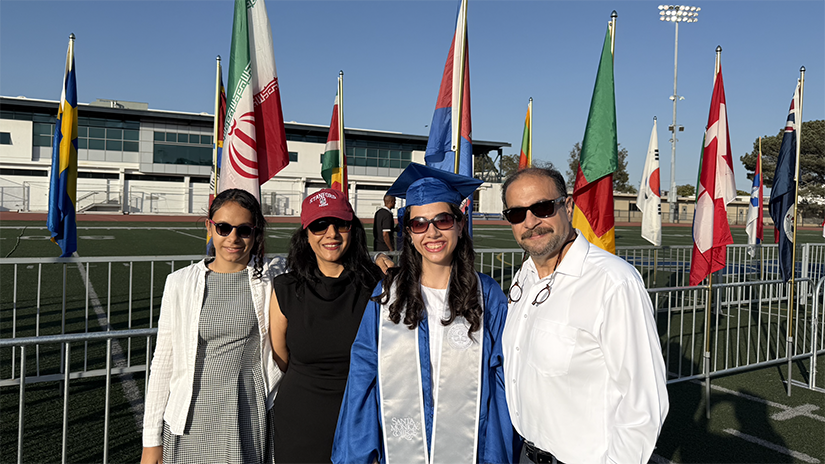
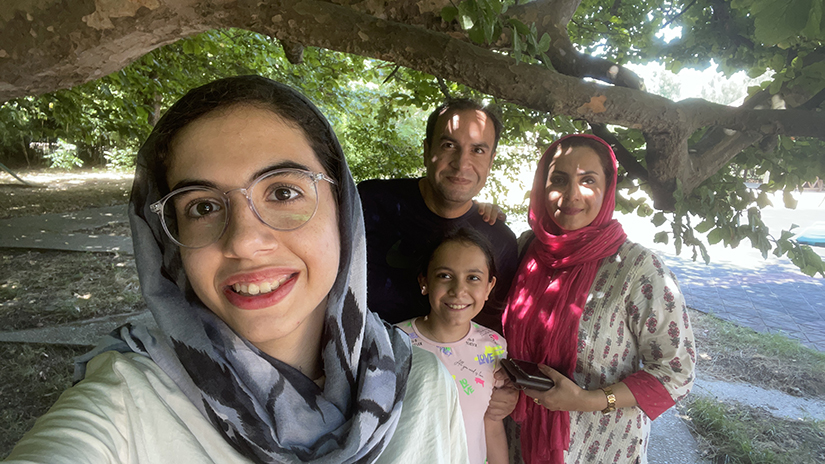
Ghazal at SMC graduation with her family

About a month after Ghazal Azhdari stepped off the plane at LAX—having just immigrated from Iran with her family—she went to enroll at Santa Monica College.
It was just a random day in the beginning of fall semester 2022. Ghazal shyly approached the first person she saw wearing an employee badge.
“Hi,” she said, in halting English. “I just arrived here, and I know nothing. I want to continue my education, but financially I’m struggling.”
To Ghazal’s amazement, that person—she never got his full name—took charge.
“He walked me to the financial aid office,” she recalls, “and stayed to help me through the whole admissions process.”
The man turned out to be an Admissions staffer. The encounter wasn’t just luck, however. Everywhere Ghazal turned, the same thing kept happening.
“Most of my conversations back then started with me saying: ‘Hi, I'm Ghazal and I have no idea what I’m doing.’” People would invariably sit her down, listen attentively, and offer concrete help.
“It’s like they were just waiting for me to ask for something. An environment I never experienced before,” she says.
That environment is about to change. Next month Ghazal begins the second phase of her undergraduate journey as an undeclared STEM major at Stanford University.
*
“I always loved school, especially science,” says the 23-year-old Corsair.
Back in Tehran, Ghazal had graduated from an accelerated chemistry program in a competitive public-private magnet.
The child of college-educated professionals, she grew up “all over Iran”—in Tehran, Isfahan and Asaluyeh. Her parents lived a comfortable life, but they wanted more for their two daughters. So when the chance to emigrate came up, they took it.
“The first few months in America were very difficult,” Ghazal recalls. “There was so much to learn—from getting your ID to opening your first bank account. Everything was new.”
Fortunately, the Azhdaris could lean on extended family. They were welcomed in the Westwood home of a cousin, and another relative pointed Ghazal to Santa Monica College. Her parents, too, have since laid roots in the neighborhood affectionately called Tehrangeles.
Formerly a commercial manager in Iran, Ghazal’s father, Ali, now works as a licensed electrician. Her mother, Elham Maleki, who holds a master’s degree in public management, is now an administrative aide working in human resources for the County of Los Angeles. Ghazal’s 12-year-old sister, Asal, is an 8th grader at Emerson Community Charter School.
*
Thanks to English professor Brian Rajski and math professor Quyen Phung, Ghazal got a running start at SMC.
“Dr. Rajski is literally the reason I can write in English, and Professor Phung is the reason I can speak in English,” she says.
Back in Iran, Ghazal had devoured English-language books and binge-watched American television and movies. Her passive language skills were excellent, “but I was terrible at writing and speaking,” she says.
She enrolled in English 1 in her first semester and struggled to keep up.
“I literally was at Dr. Rajski’s office hours every week,” she recalls. “He didn’t tell me to ‘Go take ESL.’ He sat with me patiently. And I got an A in his class. A year later I took his English 2 class, and got an A in that class too.”
In fact, Ghazal got As in all her classes. She leaves SMC with a perfect 4.0 GPA.
That first semester, Ghazal also found herself in Quyen Phung’s precalculus class. Solving the problems was easy, but explaining how she had solved the problems proved very difficult.
“Dr. Phung intentionally took me to the board and made me explain my solutions,” Ghazal recalls. Forcing her to build confidence in talking about math paid off, and the next semester, Quyen hired Ghazal as her embedded precalculus tutor.
“That was my first campus job,” Ghazal says, beaming with pride. Twelve hours a week, she coached other Corsairs and gave group demonstrations on good study habits, note-taking skills and calculator usage.
Soon Ghazal landed a second job as a science tutor at the Learning Resource Center. “Now I had to talk about chemistry another eight hours a week, trying to explain really difficult material to students in English,” she says.
By the semester’s end, Ghazal was leading high-stakes exam review sessions in one of the most difficult courses offered at SMC: Sehat Nauli’s general chemistry (Chemistry 11)
“It was Professor Nauli, who we tragically lost last semester, that helped me find the STEM Program,” Ghazal recalls. “And through the STEM program, I found my counselors, Paulette Gomez, Sheridan McArthur and Joan Kang.
“From that point, it was smooth sailing,” she says.
*
Outside work, Ghazal got involved with the Middle Eastern Club. She also co-founded the Biotech Association and the MedDent Society Student Club. On top of her tutoring jobs, Ghazal worked off-campus as a food server, barista and a doll hairstylist. (“That was the cutest job ever,” she says, of her employment with American Doll in Century City.) In her spare time, she volunteered at UCLA Ronald Reagan Hospital.
Thanks to senior career services advisor Joan Kang, Ghazal got to be a technical intern with Kite Pharma.
“That experience was life changing,” she says, of the 2024 summer program, which saw her assisting the Environmental, Health, Safety, and Sustainability (EHSS) team on compliance issues.
Her boss at Kite, Sara Hamel, went on to be Ghazal’s mentor. The two still have lunch regularly, and in June, the EHSS senior manager came to Corsair Field to watch Ghazal’s graduation.
Among SMC faculty, Ghazal singles out Quyen Phung and Sarah Baker as her top boosters. The latter recruited Ghazal to be her supplemental instruction (SI) leader for organic chemistry (Chemistry 21). Ghazal also gives shout-outs to math professors Alex Bene and Adam Richardson, who wrote glowing letters of recommendation, and chemistry professors Jamey Anderson and Timothy Dong, who guided her in independent research courses.
“These people are the best,” she says.
*
For such a hard-working high achiever, Ghazal remained conspicuously humble. The height of her ambition was to transfer to a UC.
When Paulette, her guidance counselor, mentioned elite private universities, Ghazal shrugged it off: “There’s no way I’d get accepted.” When Paulette told her about a Corsair who’d transferred to MIT the previous year, Ghazal had countered: “I don’t think I can afford it.” When Paulette mentioned full-ride scholarships, Ghazal remained skeptical.
“But Paulette kept pushing, and finally I applied,” she says.
MIT didn’t pan out, but UCLA and Stanford rolled out the welcome mat. In the end, Ghazal’s choice was financially driven. With scholarship support, she says, “Stanford was cheaper than UCLA.”
*
And now, Ghazal finds herself again at a crossroad. In September, she’ll leave the caring culture of SMC and the warm cocoon of her Westwood family home. She has no idea who she’ll be living with in Palo Alto: it’s Stanford policy to introduce dorm mates on move-in day.
Ghazal’s top interests are organic chemistry and biotechnology. Down the road, she’s eyeing a career in healthcare—perhaps an MD/PhD program.
Her parents are proud of her. As she describes what they sacrificed to come to America, Ghazal gets emotional.
“They left behind relatives and friends, the house they built piece by piece. Their careers. They had to start again from scratch,” she says.
Seeing their daughter succeed, Ghazal says, gives her parents the satisfaction of knowing that “all that hard work was for something.”
Something truly remarkable, indeed, coming from the young woman who used to begin conversations with: “Hi, I'm Ghazal, and I have no idea what I’m doing.”
* * *
SMC in Focus Volume XI, Issue 4
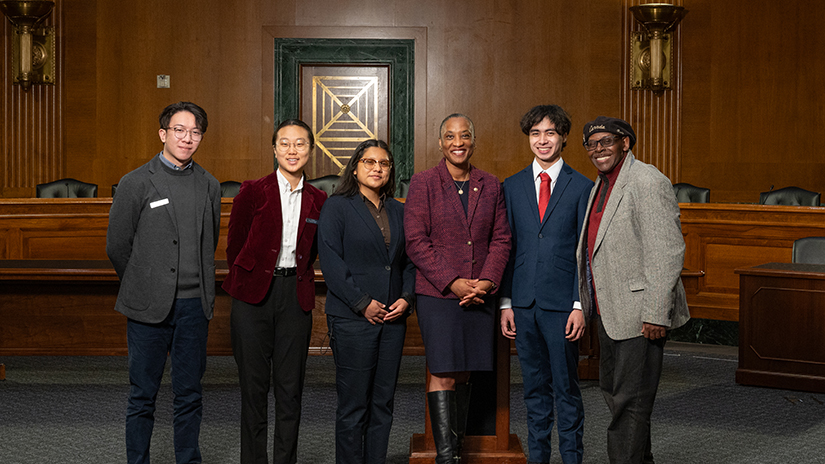
Caregiver to Changemaker
Santa Monica College enabled David Duncan to get back on track, channeling his compassion into public policy and community impact—and earning a transfer to Stanford. Read Article
Reading “College Chemistry” in Tehran
As she packs her bags for Palo Alto, Ghazal Azhdari still can’t get over how many SMC people went out on a limb to help a newly arrived immigrant succeed beyond her wildest dreams. Read Article
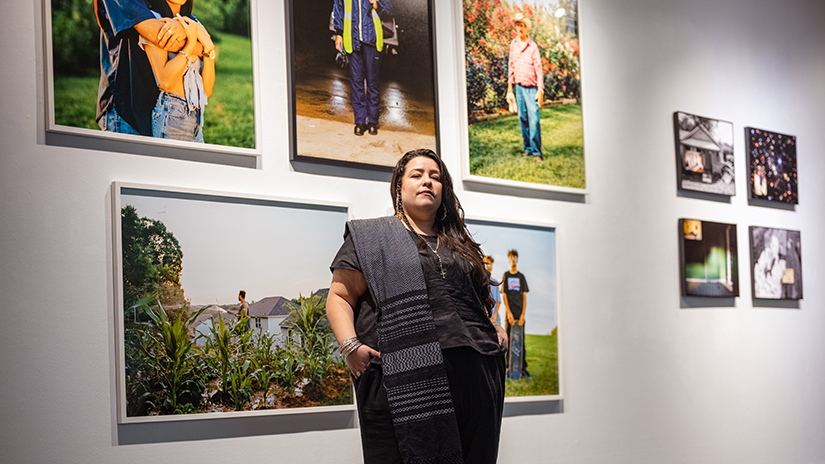
A Lens-Based Celebration of Latinidad
A timely, major exhibition “Concrete Hope”, curated by Erika Hirugami, is coming to SMC’s Barrett Art Gallery, shining a spotlight on 38 Latine/x photographers and artists. Read Article

The Singing Congressman
From Broadway musicals to campaign hustings, Brayden Handwerger’s search for the spotlight changed dramatically over his three years at SMC. Read Article

Bragging Rights
An SMC Fashion alum to produce a look for Jayne Kennedy. A first-ever Barber Battle at SMC. Studying abroad in Paris. A “Systems Changer” Award for the college. Read Article
Startup Scholar
Youthful entrepreneur Magnus Melbourne found a launching pad to the Ivy League at Santa Monica College. Read Article